Showing posts with label mobile phones. Show all posts

Wednesday, August 20, 2008

Teaching English using mobile phones

Playing shop

A couple of days ago I mentioned an idea for using audio tours as the basis for an efl/esl lesson. The actual lesson plan was for more advanced students and perhaps would not be useful for many teaching situations. So here is another idea which can be used for post beginners/intermediate students and can be more easily organised in a classroom context.

Lesson plan

1 Explain what a audio tour is. Ideally, have one ready top play on your mp3 player/mobile/PC etc. Click here to see a list of Lonely Planet Travelcasts to get some ideas.

2 Students listen to a short, easy section and then ask them in groups to discuss how this could help a tourist or visitor to their country.

3 Now explain that they are going to do their own mini audio tour/podcast/travelcast. However, this is not going to be about historic sites or landmarks but about their own home.

4 To help them with this work on the kind of vocabulary needed to describe the outside of somebody's home. Elicit ideas for categories;. For example;


type: flat, two bedroomed semi, etc.
size: small, huge, square metres, etc.
location: in the centre, next to a park, on the corner, etc.
other: old, modern, etc.


5 Students then write a short description (2 to 3 sentences) and check it with each other. the teacher quickly has a look to help or correct student work.

6 Now ask students about ways in which they can describe the inside of their home. What would we need to know?

rooms: kitchen, living room etc
colours, light yellow, bright white,
shape: square narrow, low,
atmosphere: friendly, cosy etc.

7 Explain to students that they are going to give a tour of their home and record it. The easiest way to do this is to use a mobile phone. Most models now have the ability to record audio which can then be transferred to a PC (though this is not necessary).

8 To help students oragnise their thoughts get them to draw a floor plan of their home. It maybe necessay to draw one of your own on the board to make sure they get the right idea.

9 Students then outline the route the tour will take on the plan.

10 Help them with useful phrases such as;

On the left you can see....
straight ahead is the......
just opposite......
etc.

11 Students write out their descriptions, either in full or in note form. Remind them that they are going to talk for just a few minutes and that they do not need to describe everything in too much detail. However, do get them to add a few personal details such as;

"This is my study where I revise for my exams etc."

12 Students record their descriptions on their mobile phones. Encourage them to repeat the process until they are happy with their presentation.

13 The descriptions can be posted on a class/personal blog along with either pictures or video if the students wish . Once again the mobile phone is an ideal way of doing this.

As you can see this lesson allows students to revise many areas of vocabulary such as shapes, colours, rooms, housing vocabulary, adjectives describing personal feelings etc. In addition it allows them to personalise their learning experience and finally, the act of recording and listening is a wonderful way to improve speaking skills.

For more teaching ideas using mobile - cell phones click here.

Wednesday, August 22, 2007

Using mobile - cell phones in the EFL/ESL classroom.


phones, originally uploaded by Phil Sharp (Hog).

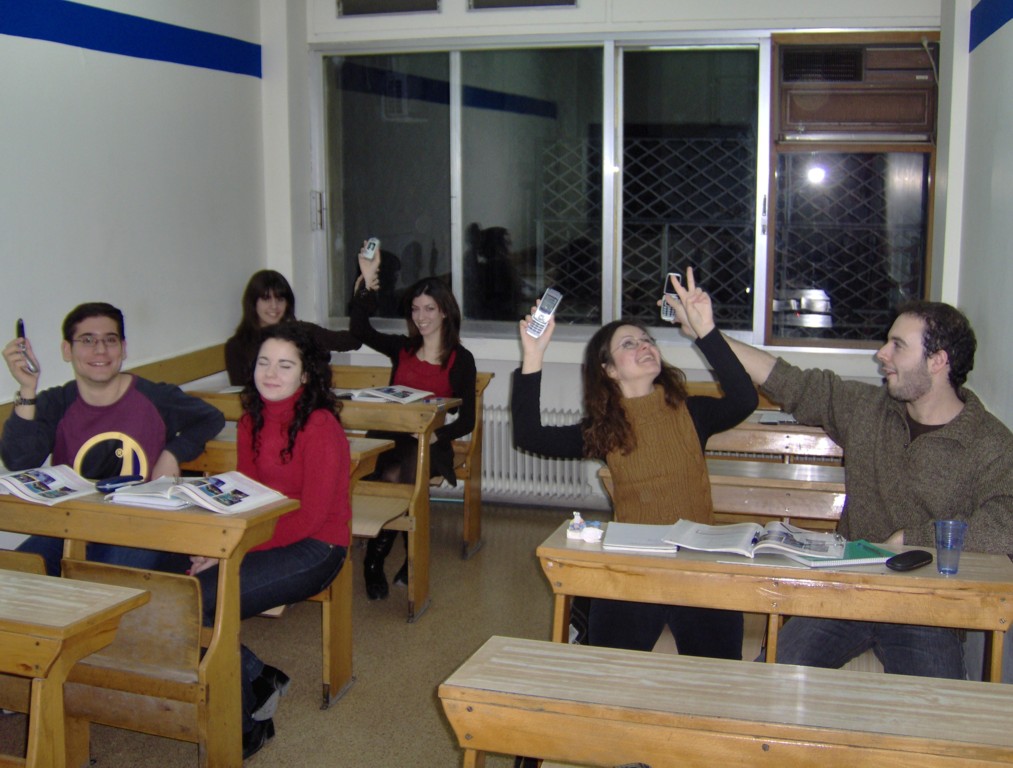
Unlike the internet which is still a novelty for many in Greece, the mobile - cell phone is king. It is rare to find anyone who doesn't own at least one. Therefore, people are familiar with the technology and most importantly for me as a teacher, it is the one thing I can guarantee that my students will bring to class with them.

The latest generation of phones have mp3 players, a half-decent camera and video recording capabilities. Put all these together and what you have is a language lab that fits neatly in the palm of your hand.

So, some ways to use your mobile to help learn English.

1 Use the mp3 player to listen to podcasts.

2 Use the player to listen to audio books while following the printed version.

3 Record yourself doing the second section of the FCE/CAE/CPE interviews. Then transcribe what you actually said.

4 Listen to small section (1 min) of a film you like on DVD (easier if you put on the English subtitles) and act it out. record your performance and then repeat until you are happy with what you hear.

5 Use the video camera on the phone to record a short segment which can be posted via Youtube to your blog.

6 Make your own music video. This can be done with either video footage or still photos. You can either use Windows Movie Maker or Photostory 3.

5 Use the camera to video sections from your course book e.g. the dialogues.

6 Get a friend to record/video you doing a FCE/ECCE/CAE/CPE interview.

7 Students video a recipe.

8 Students video a tour of their home/school/neighbourhood.

9 Students use audio recordings to create a podcast. Ideas include movie reviews, my favourite cafe, a typical day etc.

10 Record your own news story. Take a news story off the internet and change the details so that it is about you. For example, change the names, place etc so that you were the hero who saved the cat from the burning building. Then record the story.

In this way students can use digital technology even if they don't have access to a PC.

Using mobile - cell phones in the EFL/ESL classroom

Unlike the internet which is still a novelty for many in Greece, the mobile - cell phone is king. It is rare to find anyone who doesn't own at least one. Therefore people are familiar with the technology and most importantly for me as a teacher it is the one thing I can guarantee that my students will bring to class with them.

The latest generation of phones have mp3 players, a half-decent camera and video recording capabilities. Put all these together and what you have is a language lab that fits neatly in the palm of your hand.

So some ways to use your mobile to help learn English.

1 Use the mp3 player to listen to podcasts.

2 Use the player to listen to audio books while following the printed version.

3 Record yourself doing the second section of the FCE/CAE/CPE interviews. Then transcribe what you actually said.

4 Listen to small section (1 min) of a film you like on DVD (easier if you put on the English subtitles) and act it out. record your performance and then repeat until you are happy with what you hear.

5 Use the video camera on the phone to record a short segment which can be posted via Youtube to your blog.

6 Make your own music video. This can be done with either video footage or still photos. You can either use Windows Movie Maker or Photostory 3.

5 Use the camera to video sections from your course book e.g. the dialogues.

6 Get a friend to record/video you doing a FCE/ECCE/CAE/CPE interview.

7 Students video a recipe.

8 Students video a tour of their home/school/neighbourhood.

9 Students use audio recordings to create a podcast. Ideas include movie reviews, my favourite cafe, a typical day etc.

10 Record your own news story. Take a news story off the internet and change the details so that it is about you. For example, change the names, place etc so that you were the hero who saved the cat ffrom the burning building. Then record the story.

Friday, December 1, 2006

Using mobiles in the classroom


In tonight's lesson I got my Proficiency class to record themselves with their mobile phones doing a speaking exercise and then listen to their performance. The idea was that they choose a topic from the course book they want to talk about for one minute, while their partner times and records them. Afterwards they listen to their answer and their partner discusses ways in which they can improve. Then roles are reversed.

This is a great way to make students aware of any persistent mistakes they have in pronunciation.