One of the biggest difficulties facing studentslearning English in a country where English is not spoken as a first language is that they do not usually have chances to practice outside the classroom. Thankfully, the internet now allows us to overcome this obstacle. Applications such as Skype, MSN Chat and Yahoo Messsenger now incorporate phone style communication. Kantalk takes this one step further by allowing language learners to get together and communicate in the language they wish to practice.
I remember me and David, the founder of Kantalk talked about how this could be used in language learning and I expressed the concern that getting complete strangers to chat at length is a bit difficult. I thought that the service would work better if people could talk about a particular topic or theme.
Now Kantalk has introduced an extra service in which anyone can invite others to follow a lesson plan. If you are feeling creative then why not add your one of your own? I added this one earlier today based on something I posted on the blog.
Showing posts with label speaking. Show all posts
Showing posts with label speaking. Show all posts
Saturday, December 22, 2007

Saturday, October 27, 2007
Kantalk - Using the internet to practice speaking skills
One of the problems students face when studying English is that they have limited chances to speak the language outside the class. Unless you're lucky to move in English speaking circles then you are going to find it hard to practice these skills. Luckily, once again the internet has the solution in the shape of Skype.Now anyone with a fast internet connection and a microphone can speak free of charge. Even better Kantalk has been created for those who want to practice foreign language skills with others from all over the world.
Taking this concept a step further they have now created lesson plans which allow people to discuss various topics with others online. Check out their lesson on TV here.

Taking this concept a step further they have now created lesson plans which allow people to discuss various topics with others online. Check out their lesson on TV here.
Sunday, October 22, 2006
Hotel mime game

Here's an exercise I use as either a warm up for more advanced students or an revision activity at the end of a lesson to practice a particular vocabulary area. It can be used with any number of different learning tasks.
Lesson plan
1 Tell students that they are on holiday in London/New York etc. The only problem is that they have a terrible sore throat and so are unable to utter a word.
2 If that was not enough you have some problems with your hotel and you have to go the reception to complain.
3 Explain to the students that they have to explain their problems through mime. Do an example to give them a better idea of what you want.
E.g. There are not towels in my bathroom.
4 Divide the class into two teams. Elicit a name for each team
5 One student from each group comes to the front of the class, is shown a situation from the handout and then has two minutes to mime the situation to the other members of his/her team. If the team fails to get the right answer the other team has a chance to guess.
6 Then the other team has their turn.
7 Repeat as many times as you wish (though, I reckon four to five each is a good number, otherwise they start to get restless).
8 The winning team is the one with the most correct guesses
HOTEL MIME GAME
1 There are no towels in my bathroom.
2 The bed hasn't been changed.
3 I can't turn off the air conditioning.
4 My room is very dirty.
5 I need to be woken up at 8am tomorrow morning.
6 I would like breakfast in bed.
7 I'd like to order a salad and a can of orangeade from room service.
8 I want to use the hotel gym.
9 Where is the nearest post office?
10 Can you give me change for a 100 euro note ?
The same idea can be used for crimes, the supermarket, school etc.
2 The bed hasn't been changed.
3 I can't turn off the air conditioning.
4 My room is very dirty.
5 I need to be woken up at 8am tomorrow morning.
6 I would like breakfast in bed.
7 I'd like to order a salad and a can of orangeade from room service.
8 I want to use the hotel gym.
9 Where is the nearest post office?
10 Can you give me change for a 100 euro note ?
The same idea can be used for crimes, the supermarket, school etc.
Wednesday, October 18, 2006
Travel and EFL/ESL teaching
This is a low - tech exercise that I've done a lot over the last few years to help intermediate EFL/ESL students practice speaking skills. It is now especially relevant for the ECCE interview which asks students to take a more active role in the interviewing process.
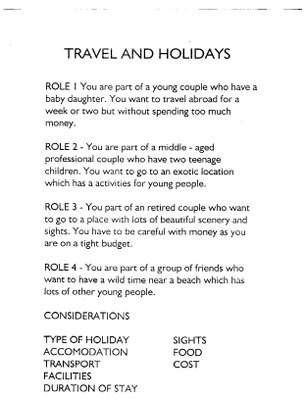
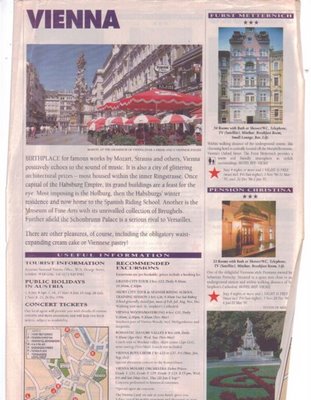
For this you'll need some pages out of a travel brochure and a photocopies of the handout below.
LESSON PLAN
1 In groups of three/four students ask each other about a holiday they been on. Remind them to ask;
Where did you go?
When did you go ?
Where did you stay?
What did you do there?
What made it so special?
2 Now explain to the students that they're going to do an exercise where they have to either choose a holiday or sell one.
3 Divide the class into two groups: Travel agents and holiday makers.
4 Make sure that everyone understands the terms before proceeding.
5 Divide the "travel agents" into pairs and give them each a page from a travel brochure. Explain that they have ten minutes to figure out what the page means as they have to be able to tell customers all about the holiday they are offering.
6 Give each of the "holidaymakers" the handout and assign one of the four roles. Explain to them that they have ten minutes to think about what kind of holiday would suit them and write down suitable questions to ask the travel agents, using the prompts provided.
7 Get the travel agents to set up shop, i.e. move their desks so everyone has easy access and write a sign which shows the place they are offering holidays to.
8 The holiday makers now go to the travel agents in order to find out information about the destination and eventually come to a decision. Make sure that they see as many travel agents as possible. This phase should last between 10 and 15 minutes.
9 The holiday makers then report back to the teacher about the reasons behind their holiday choices.
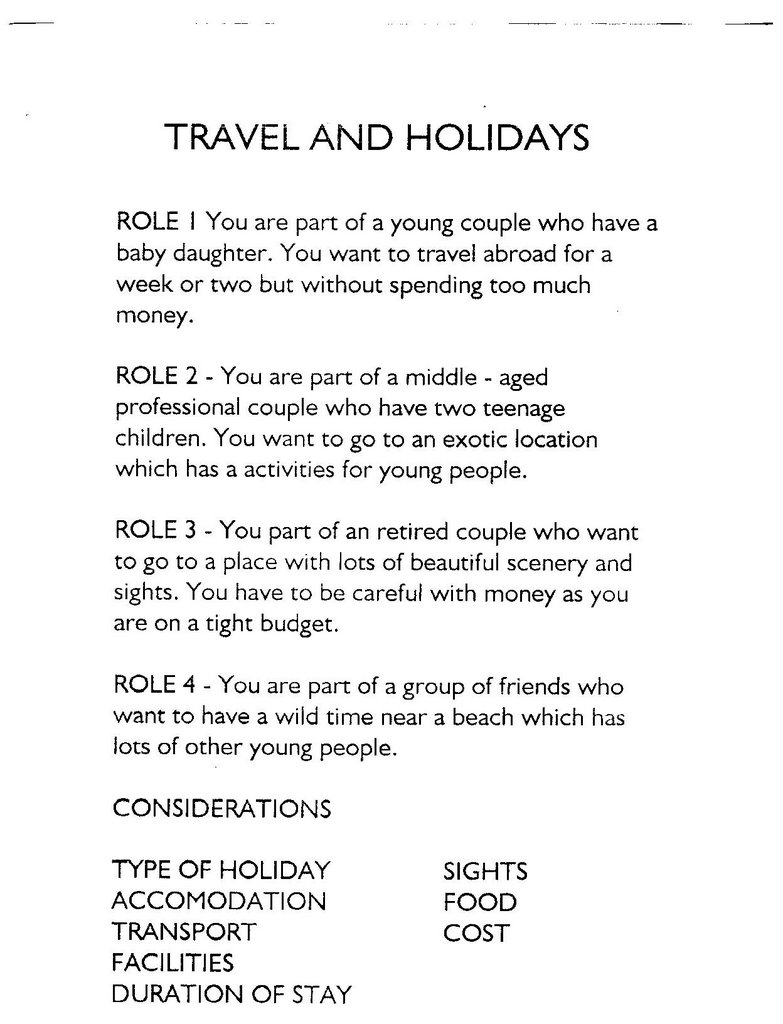
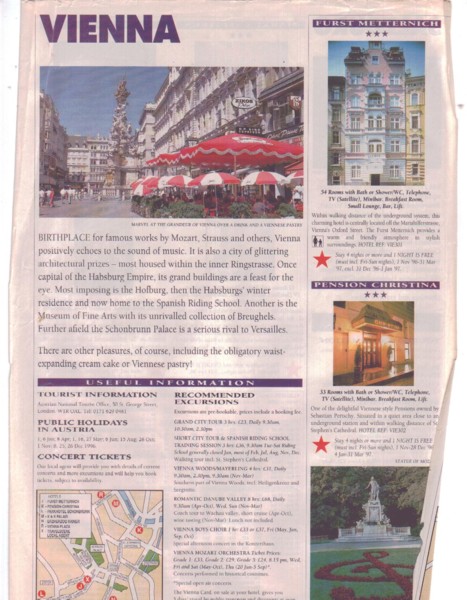
For this you'll need some pages out of a travel brochure and a photocopies of the handout below.
LESSON PLAN
1 In groups of three/four students ask each other about a holiday they been on. Remind them to ask;
Where did you go?
When did you go ?
Where did you stay?
What did you do there?
What made it so special?
2 Now explain to the students that they're going to do an exercise where they have to either choose a holiday or sell one.
3 Divide the class into two groups: Travel agents and holiday makers.
4 Make sure that everyone understands the terms before proceeding.
5 Divide the "travel agents" into pairs and give them each a page from a travel brochure. Explain that they have ten minutes to figure out what the page means as they have to be able to tell customers all about the holiday they are offering.
6 Give each of the "holidaymakers" the handout and assign one of the four roles. Explain to them that they have ten minutes to think about what kind of holiday would suit them and write down suitable questions to ask the travel agents, using the prompts provided.
7 Get the travel agents to set up shop, i.e. move their desks so everyone has easy access and write a sign which shows the place they are offering holidays to.
8 The holiday makers now go to the travel agents in order to find out information about the destination and eventually come to a decision. Make sure that they see as many travel agents as possible. This phase should last between 10 and 15 minutes.
9 The holiday makers then report back to the teacher about the reasons behind their holiday choices.
Sunday, September 17, 2006
Spot the difference

If you've ever done a spot the difference exercise then you should be familiar with the basic idea. You can also use for teaching EFL. Divide the class into two groups Give one group a copy of the top picture (which they cannot show their partner) and the other group the bottom picture. The idea is that in pairs the students find out the differences just by describing their own photos). It is also a good way of preparing students for the FCE interview (part 2) which students, amongst other things) have to compare and contrast two photos.
Subscribe to:
Posts (Atom)