Showing posts with label education. Show all posts

Friday, March 14, 2008

Picasso rated R for Greek students


An exhibition of work by by Picasso in the northern Greek city of Thessaloniki has been judged unsuitable for high school students.


The director of the secondary education in East Thessaloniki, Mr Theodoros Tapanidis withdrew approval for the participation of junior and senior high school students in the exhibition, Picasso 347 Suite at the Telleiogleio Art Foundation. Mr Tapanidis told the Makedonia newspaper that he was responding to telephone calls by parents and students that the exibition contained "indecent images" He is quoted as saying; "Just because its Picasso, when there is an exhibition we can just show the children anything?"


The ban sparked a stream of protests by local politicians and educators who have condemned the decision as censorship and "medieval".


However, Museum official today said that the ban had been lifted and that students were once again able to visit the gallery, as long as their teachers approved.


The Picasso 347 Suite exhibition, which contains 347 pieces created by Picasso in 1968, will be open to the public until 16th April


Picasso rated R for Greek students Picasso rated R for Greek students

Tags: | | | | | |

Sunday, June 24, 2007

An Inconvenient Truth


After all this time I managed to see An Inconvenient Truth and I just got to say that it has been a long time since a movie has touched me so deeply, let alone a documentary. Rather then preach about the evils of global warming myself, I'd just recommend you see Al Gore's film yourself and make up your own mind.

As I sit in 40c heat, rare even for Greece in June after the warmest winter I have ever experienced here I, personally just can't deny the evidence any more.


For ideas about how to use the film in class - click here.

To find out more about this issue go to www.climatecrisis.net

Tuesday, May 8, 2007

Theatrical performance


Over the weekend I took Lydia to see a wonderful theatrical performance by the Paidiko Steki Rethemou (Παιδικο Στεκι Ρεθυμνου). They are part of an alternative educational philosophy which seeks to empower learners and break down authoritarian teacher - student roles.

For more ideas on this check out the El Paso Paidiko Steki (Ελευθεριακο Παιδικο Στεκι El Paso) - It's only in Greek but when I get time I'll translate some of it into English.

Saturday, February 10, 2007

A postcard from the nineteenth century

Today I was helping my daughter (aged seven) with her homework and she asked me to check put some exercise she'd been given to do over the weekend. As well as the usual times tables she asked me to look at the following activity;

For those of you who don't read Greek, it is a declension of masculine, feminine and neutral nouns in Greek along with with an exercise which asks them to give example of various tenses such as present perfect, future simple etc.

For anyone who studied Latin or Ancient Greek, I'm sure the format is familiar, however, trying to teach young learners in this fashion is madness. It shows an almost total lack of understanding of the way in which children learn. Imagine teaching a second grader English by asking them to list the differences between the present perfect continuous and past simple. The ironic thing is that I can't help my daughter with these exercises because I never bothered to learn the ludicrously complex (not to mention outdated terminology) used to teach syntax in Greek. Instead, I actually went out and used the language to read, write, speak etc.

The exercises Lydia has to do are all set out by the ministry of education and have to be followed to the letter by teachers in elementary school. (see here for the curriculum and material). I'm starting to believe the the school curriculum in Greece is the longest suicide note in history. How is this generation going to compete in a global economy where their peers learn skills at, say ten that they won't till they reach university, if at all?

If you believe that this is an exaggeration then tell me where in the country students in the public education system can do what these American fourth graders can?

Friday, February 9, 2007

By the way, the 19th century is over

I came across this great video whilst over at Cool Cat Teacher's blog and it just about sums up everything I've been trying to do via my lessons over the last few years. As well as teaching English I've been trying to impart to my students, irrespective of age, how we are now part of a truly global economy and that much of we'll need in the future can not be found in the antiquated education system they have to endure.

Friday, November 17, 2006

Mind blowing ideas

In a good month I get about 2000 visitors to this blog, a number that far exceeds my wildest expectations when I started it, however, imagine a school that gets 1.5 million visitors a month to their site. No, not a world famous university, multi-national corporation or big name e-retailer, but a middle school in Georgia, USA.

When I was over at ever interesting Cool Cat Teacher blog I came across an interview Vicky did (listen here) with the Principle of Mabry Middle School, Dr Tim Taylor, who set up the site.
The school is a world leader in the integration of technology into teaching practice and the amazing thing is how low cost and easily accessible most of the tools are. For example, the site itself is, in fact as series of connected Movable Type blogs. What you can't put a price on though, is the sheer inventiveness and creativity of those teachers and students that are making this idea a practical reality.

I found the student produced video particularly amazing. Now that I've figured out how to post stuff on YouTube and have access to broad band at school and at home I'm definitely going to start on some of the video projects I blogged about during the summer.

Check out their film festival here.

Monday, November 13, 2006

Don't think - learn !


I came across this Remote Access blog today which really crystallises many of the thoughts I've been having over the last few years;

"I'm getting to the point where I want to be finished with old ways. I truly believe that we are actively harming the kids in our classrooms when we are not preparing them for the society they live in. But more and more I roll around at night, get up early in the mornings and wonder what those new ways look like. Do we even know what we want? What would a classroom that actively supports kids in learning the skills which will best prepare them to be active, informed, concerned citizens in the twenty first century look like? If we could do anything, what would it be?"

As my daughter gets older and has entered the Greek educational system I become more and more worried about the quality of education she's receiving. It's not just the endless strikes and lost days but something much more fundamental. What exactly does this system want to achieve? If you've listened to the various ministers of education over the years, they all say that they want well-rounded individuals able to deal with the challenges of the modern world. Yet, like so many of their pronouncements, the wonderful statements bear little or no relation to the reality I see in schools and in the knowledge and skills that the students acquire.

Whilst the system may not be preparing kids for the demands of the twenty-first century,

"it was the ideal preparation for the Organization Man economy, a highly structured world dominated by large, bureaucratic corporations that routinized the workplace. Compulsory mass schooling equipped generations of future factory workers and middle managers with the basic skills and knowledge they needed on the job. The broader lessons it conveyed were equally crucial. Kids learned how to obey rules, follow orders, and respect authority -- and the penalties that came with refusal."

Daniel H. Pink - School's Out

The problem is that world is fast changing, disappearing even, and still the curriculum, with its heavy emphasis on theory and it's chronic distaste for practical application of knowledge continues to churn out thousands of students with precious few marketable skills, crammed with "facts" like some kind of goose being prepared for the production of liver pate.

I think the most damning indictment of the present situation came from the mouth of an ten year old student I was teaching English to last week. At the end of the lesson she sighed that she now had to study her history homework. When I asked her what she had to do, she replied that she had to learn a page from the book by heart. The passage, which was about the difference between an aristocratic and a democratic form of government in ancient Athens, was way beyond what you could reasonably expect from an ten-year old. She read out the passage and when I asked what she understood, she said, "nothing". But as her sister, who is seventeen said, if she wants a good grade what she had to do was learn it by heart. The saddest thing about this whole story is that her sister is right. As long as she can repeat in class the teacher will be happy.

The moral of the story?

Don't think - learn !

Thursday, April 6, 2006

Preparing students for the challenges of the nineteenth century


I had a lesson recently which kind of shocked me as it revealed that that teaching using blogs, podcasts, mp3's etc is going to be a lot harder than I had imagined. I asked one of my younger students if she had had the chance to see the interview we had done on her computer. She said that she hadn't as she didn't know how to move the file from the cd to the hard disk!!!

I have no reason to believe that she was lying as she is an intelligent and conscientious student. Yet my heart drops when I realise that even the smartest kids have not been taught even the most basic of computer skills in their regular schools.

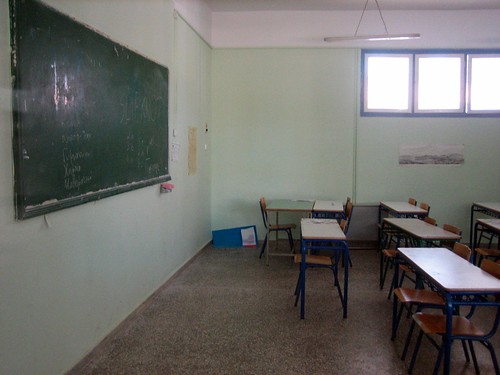
To enter a classroom here is to travel back in time 50 years. With the exception of the presence of electricity and central heating there is nothing to distinguish a classroom now from one in the fifties. Bare walls painted institutional green, desks which should have gone out with the slide rule and bars on the windows are the dominant features of most classrooms.

Unfortunately, the "teaching" that often takes place in these places is as just as impoverished as the physical surroundings.